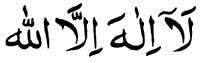

lā ilāha illā allāh
The Arabic phrase lā ilāha illā allāh is one of major pillars of
the Muslim faith. This sacred phrase is a part of the basic Muslim statement
of faith, it is a part of the call to prayer that echoes across the
country-side five times a day throughout the Muslim world, it is chanted as
a central part of virtually every Sufi gathering, and it appears in two
verses of the glorious Qur'ān as follows:
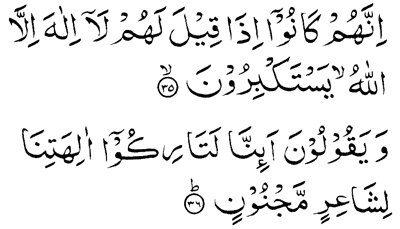
For they when they were told that Sura
as-Saffat (37:35-36)
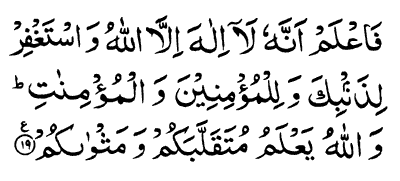
Sura Muhammad (47:19) click this link to hear Shaikh Saad al-Ghamdi recite this verse FaAAlam annahu la ilaha illa Allahu wastaghfir lithanbika walilmu'mineena walmu'minati wallahu yaAAlamu mutaqallabakum wamathwakum
and has been translated into English as:
Note: a mark (bar) over a vowel indicates that is a long vowel. When written as part of a sentence where Allah is the subject, there will be a "u" at the end of Allah, denoting that Allah is indeed the subject. Thus, in the verses of al-Qur'an shown above, the phrase is written as lā ilāha illā allāhu. When used as an entire sentence, such as the call to prayer (adhan), the "u" at the end is absent, and the phrase becomes simply lā ilāha illā allāh. For some guidance on Arabic pronunciation, click on the following link to hear the phrase lā ilāha illā allāh recited, chanted or sung by a variety of native-speakers: audio recordings of lā
ilāha illā allāh
Allah, (there is) no god but He,
tr by M. Ali Allahu la ilaha illa huwa al-hayyu
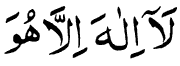
al-qayyoom The word huwa is a third-person singular masculine nominative pronoun that is, in general, translated into English as he. Since both Arabic and English lack a neuter gender nominative pronoun with which to refer to Allāh, the Arabic huwa, when referring to Allāh, could be well expressed with the English translation That One. The phrase lā ilāha illā huwa is written in Arabic as:
and has been translated into English as:
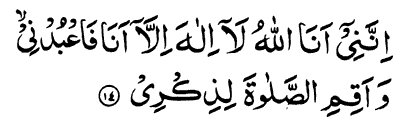
lā ilāha illā anā Another similar phrase used a few times in the Qur'ān is lā ilāha illā anā, which appears, for example, in Sūrah Tā Hā (20:14) as:
Innanee ana Allahu la ilaha
illa ana faAAbudnee waaqimi assalata lithikree
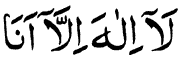
The phrase lā ilāha illā anā is written in Arabic as:
The word anā is a first-person singular pronoun, generally translated into English using either the pronoun I or me. The phrase lā ilāha illā anā has been translated into English as:
For more word-by-word translations from Arabic, see the following pages on this web site:
Wishing you love, harmony and beauty, last updated 18-Oct-2005 rev 11-Aug-2019 la ilaha illa allah, la ilaha illa-llah, la ilaha illallah, la ilah il allah, there is nothing to worship other than Allah, tahlil, tahleel, al quran, la ilaha illa ana, there is none to worship except Me, la ilaha illa huwa, there is none to worship except That One |