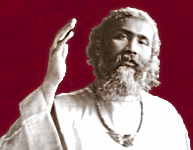
The Life and Teachings of Hazrat Inayat Khan
Inayat Khan was born in Baroda, India on July 5, 1882. As a youth,
Inayat was brilliant in poetry and music, yet his deepest inner
calling was in spiritual matters. As a youth, one day as Inayat
was praying...
... he thought to himself that there had not been an answer
yet to all the prayers he had offered to God and he did not
know where God was to hear his prayers and he could not reconcile
himself to going on praying to the God whom he knew not. He
went fearlessly to his father and said: "I do not think I will
continue my prayers any longer, for it does not fit in with
my reason. I do not know how I can go on praying to a God I
do not know." His father, taken aback, did not become cross
lest he might turn Inayat's beliefs sour by forcing them upon
him without satisfying his reason and he was glad on the other
hand to see that, although it was irreverent on the child's
part, yet it was frank, and he knew that the lad really hungered
after Truth and was ready to learn now, what many could not
learn in their whole life.
He said to him: "God is in you and you are in God. As the
bubble is in the ocean and the bubble is a part of the ocean
and yet not separate from the ocean. For a moment it has appeared
as a bubble, then it will return to that from which it has risen.
So is the relation between man and God. The Prophet has said
that God is closer to you than the jugular vein, which in reality
means that your own body is farther from you than God is. If
this be rightly interpreted, it will mean that God is the very
depth of your own being." This moment to Inayat was his very
great initiation, as if a switch had turned in him, and from
that moment onward his whole life Inayat busied himself, and
his whole being became engaged in witnessing in life what he
knew and believed, by this one great Truth.
 Inayat's
early life primarily revolved around music, and he was given many
awards and medals of honor for his magnificent singing. In 1903
Inayat published a Hindustani collection of some 75 songs as Professor
'Ināyat Khān Raḥmāt Khān Paṭhān.
Inayat's
early life primarily revolved around music, and he was given many
awards and medals of honor for his magnificent singing. In 1903
Inayat published a Hindustani collection of some 75 songs as Professor
'Ināyat Khān Raḥmāt Khān Paṭhān.
Following a vision of meeting a Sufi teacher, he met Muhammad
Abu Hashim Madani who trained him in the ways of the Chishti, Naqshbandi,
Qadiri, and Suhrawardi Sufi orders.
... an incident of an amusing nature occurred as for the
first time in his life Inayat heard his Murshid's words on metaphysics.
He became so keenly interested and filled with enthusiasm about
what was being said that he took a note-book from his pocket,
intending to take notes of it. But as soon as the Murshid saw
the pencil and notebook in his hand, he instantly began to speak
of an altogether different subject. Inayat realized by this
that his Murshid meant that his words must be engraved on the
soul, they were not to be written with a pencil on the pages
of a note-book.
He would return home silent and remain
speechless for hours, pondering over the words which had fallen
upon his ears. His friends began to wonder what could have happened
to him in such a short time, that his whole life should be so
changed. He had now become quite a different person in his speech,
actions, ways, expression, in his attitude and in his atmosphere.
In all these, he showed a marked and definite change. It seemed
to them as if, while a traveler walking at a certain rate of
speed should have journeyed a mile, Inayat had suddenly made
such an advance as to cover a hundred miles in the same space
of time...
[his Murshid] used to wear shoes embroidered with gold. One
day, when Inayat's eyes strayed to these shoes, a thought arose
in his mind: why Murshid with all his simplicity should wear
such costly shoes? At once his conscience pricked him, he felt
so guilty that such a thought of one who was above question
should have entered his mind, that instantly his face turned
pale. But the Murshid knew all about it and only said with a
smile: "The wealth of this earth is only worth being at my feet."
In looking back on those days with his teacher, Inayat said:
I remember my murshid giving me, in blessing me, this wish,
'May your faith be strengthened.' Being a young man, I thought,
'Is that all he is saying to me?' - not, 'May you be inspired,
or illuminated, or prosperous,' or something else? But when
I think of it now I know that in that blessing there was all.
When belief is strengthened, then there is everything. All that
we lack in life is mostly because of our lack of belief. But
again, it is not something that one can learn or teach or that
one can give to anybody. This comes from the grace of God.
Inayat began a tour of the sacred sites across India, and early
in that adventure, he met the son of Guru Manek Prabhu who asked:
"What has brought you here?" said he and Inayat replied:
"I have heard that the home of Manek Prabhu is not only a religious
temple, but a centre of music also and as I have taken this
tour to pay homage to the holy men living on the soil of India,
I first chose to visit this place." "But I am very surprised
that you have chosen our place, instead of choosing the place
of some Muslim Saint," remarked the astonished youth. To this
Inayat replied: "Muslim or Hindu are only outward distinctions,
the Truth is one, God is one, life is one. To me there is no
such thing as two. Two is only one plus one."
... "Mukti (liberation) is the ideal of life; it is the rising
above the various births and deaths, rather than being involved
in the eternal wheel of births and deaths, which is continually
running by the ever changing battery of karma (action)."
After touring widely in India and and briefly settling in Calcutta,
Inayat began to realize that the time had come for him to begin
a new phase of life.
Inayat lived in Calcutta for several years and there received
the news of the death of his beloved father, which was to him
a blow inexpressible in words, though thus his life became free
from any duty binding him as a sacred tie, as he had felt his
duty toward his parents to be. Soon after this another misfortune
befell him, namely the loss of his medals. In a moment of abstraction
the case of medals was left in a car, which could not be traced
despite all his efforts. But in place of the disappointment
which at first oppressed him, a revelation from God touched
the hidden chords of his mind and opened his eyes to the truth.
He said to himself: "It matters not how much time you have spent
to gain that which never belonged to you, but which you called
your own; today you comprehend it is yours no longer. And it
is the same with all you possess in life, your property, friends,
relations, even your own body and mind. All which you call 'my',
not being your true property, will leave you; and only what
you name 'I', which is absolutely
disconnected with all that is called 'my', will remain." He
knelt down and thanked God for the loss of his medals, crying:
"Let all be lost from my imperfect vision, but Thy true Self,
ya Allah!"
Shortly before the death of his beloved teacher, Inayat had been
instructed:
"Fare forth into the world, my child, and harmonize the East
and the West with the harmony of thy music. Spread the wisdom
of Sufism abroad, for to this end art thou gifted by Allah,
the most merciful and compassionate."
To fulfill that mission, Inayat along with his cousin and brother
sailed from India to America on September 13, 1910. In his
autobiography, Inayat
wrote of that voyage:
I was transported by destiny from the world of lyric and
poetry to the world of industry and commerce on the 13th of
September 1910. I bade farewell to my motherland, the soil of
India, the land of the sun, for America the land of my future,
wondering: "perhaps I shall return some day", and yet I did
not know how long it would be before I should return. The ocean
that I had to cross seemed to me a gulf between the life that
was passed and the life which was to begin. I spent my moments
on the ship looking at the rising and falling of the waves and
realizing in this rise and fall the picture of life reflected,
the life of individuals, of nations, of races, and of the world.
I tried to think where I was going, why I was going, what
I was going to do, what was in store for me. "How shall I set
to work? Will the people be favorable or unfavorable to the
Message which I am taking from one end of the world to the other?"
It seemed my mind moved curiously on these questions, but my
heart refused to ponder upon them even for a moment, answering
apart one constant voice I always heard coming from within,
urging me constantly onward to my task, saying: "Thou art sent
on Our service, and it is We Who will make thy way clear." This
alone was my consolation.
Initially, their public performances centered on Indian music
and they accompanied dancers such as Mata Hari and Ruth St. Denis
in both America and Europe.
I found Miss Ruth St. Denis an inventive genius, and I was
struck with a witty answer she gave upon hearing my ideas about
human brotherhood, uniting East and West. She said, "Yes, we,
the people of the Occident and Orient may be brothers, but not
twins."
In addition to the musical performances, Inayat gave Sufi lectures
that were often held in bookstores or homes. Rabia Martin, of San
Francisco, became one of his first students and was soon appointed
as his American representative.
I had a vision that night that the whole room became filled
with light, no trace of darkness was to be found. I certainly
thought that there was some important thing that was to be done
next day, which I found was the initiation of Mrs. Ada Martin,
the first mureed on my arrival to the West and, knowing that
this soul will spread light and illuminate all those who will
come in contact with her, I initiated her and named her Rabia
after the name of a great woman Sufi saint of Basra.
Inayat traveled widely in America and Europe from 1910 until
1920, when he set up a residence in France, where he focused on
summer schools, classes and lectures.
His message was always aimed at unity, bringing together all
of humanity, rising above the differences and distinctions
that have separated us.

One day a visitor came to have an interview with Pir-o-Murshid.
He was a lawyer, materialist and atheist, besides was greatly
opposed to all those who did not belong to his nation, and had
been turned against the work of Murshid by somebody. Therefore
he began his conversation, expressing with vigor his attitude.
But as he got answers, so it seemed as if the fire of opposition
met with water, and as he went along in his dispute, he, instead
of getting hotter became cooler. He had expected to hear from
the Murshid spiritual beliefs that he could argue upon and to
tear them to pieces, but he found Murshid's belief not very
different from what he himself believed. He found no effort
on the part of Murshid to force his ideas upon anybody. He saw
in Murshid the tendency to appreciate every kind of idea, for
in every idea there is a good side and he felt that the tendency
was to be sympathetic rather than antagonistic. He saw that
there was nothing that Murshid stood for, but only believed
that the truth was in every heart and no-one else can give it
to another unless it rose up from the heart of a person as a
spring of water from the mountain. He became so softened in
his tone and in his manner after an hour's conversation that
he parted quite a different man from what he had come. He shook
hands with Pir-o-Murshid and said, "We shall always be friends"
and Murshid thought that it was not a small achievement.
In this uniquely western form of Sufism, there are no barriers
of race, creed or religion, it is not a religion, but rather a way
of life that enhances and fulfills every religion. As Inayat Khan
said, "The Sufi sees the truth in every religion."
"You have nicely said to us, Murshid, how Sufism is one with
all religions. Now please tell us, what is the difference between
Sufism and other religions."
Then Murshid said, "The difference is that it casts away
all differences."
Inayat promoted unity and understanding in every aspect of life,
and said "religion is the foundation of the whole life in the world,
and as long as an understanding is not established between the followers
of all different religions, it will always be difficult to hope
for better conditions."
In speaking about mankind's longing for the Divine message, yet
rebelling against every messenger that has ever come to show the
way, Inayat once wrote:
... who can answer this demand? He alone who is sent from
above, who is appointed by God to deliver His Message, who is
empowered by the Almighty to stand by them in their struggles,
and who is made compassionate by the most Merciful to heal their
wounds. Man wants something he cannot get, man wishes to believe
in something he cannot understand, man wishes to touch something
he cannot reach. It is the continual struggle for the unattainable
that blinds man, and he forms such high ideas even of the prophet
who is only a Messenger, a human being, one like every one else,
and who is subject to death and destruction and all the limitations
of life, that the prophet does not seem to come up to man's
ideal until he has left the world, leaving behind the memory
which again rises as a resurrection of the prophet, spreading
the influence of all he brought to the world and pouring from
above that blessing which arose as vapor and came back from
above as a rainfall.
The Sufi Message of Inayat Khan is the echo of the same Divine
message which has always come and will always come to enlighten
humanity.
This is not a new religion or a new message; it is the same message
of Unity and Brotherhood which has been given to humanity again
and again, yet so few hearts are open to hear it.
The Sufi movement is a group of people, belonging
to different religions, who have not left their religions but have
learned to understand them better; and their love is in life, as
the love for God and humanity, instead of for a particular sect.
The principle work that the Sufi movement has to accomplish
is to bring about a better understanding between East and West and
between the nations and races of this world. And the note that the
Sufi message is striking at the present time is the note which sounds
the divinity of the human soul – to make human beings recognize
the divinity in the human soul.
If there is any moral principle
that the Sufi movement brings, it is this: that the whole humanity
is as one body; and any organ of that body, hurt or troubled can
cause trouble to the whole body, indirectly. And as the health of
the whole body depends on the health of each part, so the health
of the whole humanity depends upon the health of every nation.
Besides this, to those who are awakening and feel that now
is the moment; when they feel inclined to know about the deeper
side of life, of truth; to them the Order extends a helping hand;
without asking to what religion, sect, or dogma, they belong.
The knowledge of the Sufi is helpful to every person, not
only in living his life aright, but in his own religion. The Sufi
movement does not call man away from his belief or church – it calls
man to live it. In short, it is a movement intended by God to unite
humanity in brotherhood, in Wisdom.
Social Gatheka 28, The Sufi's Aim in
Life, Hazrat Inayat Khan (unpublished)
Speaking to his students, Inayat described the central theme
of his efforts as:
The central theme of the Sufi Message is one
simple thing, and yet most difficult, and that is to bring about
in the world the realization of the divinity of the human soul,
which hitherto has been overlooked, for the reason that the time
had not come. The principal thing that the Message has to accomplish
in this era is to create the realization of the divine spark in
every soul, that every soul according to its progress may begin
to realize for itself the spark of divinity within. This is the
task that is before us.
Now you may ask, what is the Message?
The Message is this: that the whole humanity is as one single body,
and all nations and communities and races as the different organs,
and the happiness and well-being of each of them is the happiness
and well-being of the whole body. If there is one organ of the body
in pain, the whole body has to sustain a share of the strain of
it. That by this Message mankind may begin to think that his welfare
and his well-being is not in looking after himself, but it is in
looking after others, and when in all there will be reciprocity,
love and goodness towards another, the better time will come.
Addresses to Cherags, Our Sacred Task,
Hazrat Inayat Khan (unpublished)
The need of the world today is not learning,
but how to become considerate towards one another. To try and find
out in what way happiness can be brought about, and in this way
to realize that peace which is the longing of every soul; and to
impart it to others, thereby attaining our life's goal, the sublimity
of life.
Sufi Mysticism, Problem of the Day, Hazrat Inayat Khan
To further elaborate on the mission and the methods
employed to develop one's inner life, Inayat wrote:
There are ten principal Sufi thoughts which
comprise all the important subjects with which the inner life of
man is concerned:
1) There is one God, the Eternal, the Only
Being; none else exists save God.
2) There is one Master,
the Guiding Spirit of all souls, who constantly leads all followers
towards the light.
3) There is one Holy Book, the sacred
manuscript of nature, which truly enlightens all readers.
4) There is one Religion, the unswerving progress in the right
direction towards the ideal, which fulfils the life's purpose of
every soul.
5) There is one Law, the law of Reciprocity,
which can be observed by a selfless conscience together with a sense
of awakened justice.
6) There is one human Brotherhood, the
Brotherhood and Sisterhood which unites the children of earth indiscriminately
in the Fatherhood of God.
7) There is one Moral Principle,
the love which springs forth from self-denial, and blooms in deeds
of beneficence.
8) There is one Object of Praise, the beauty
which uplifts the heart of its worshipper through all aspects from
the seen to the unseen.
9) There is one Truth, the true knowledge
of our being within and without which is the essence of all wisdom.
10) There is one Path, the annihilation of the false ego in
the real, which raises the mortal to immortality and in which resides
all perfection.
The objectives of the Sufi path:
1) To realize and spread the knowledge of unity, the religion
of love and wisdom, so that the bias of faiths and beliefs may of
itself fall away, the human heart may overflow with love, and all
hatred caused by distinctions and differences may be rooted out.
2) To discover the light and power latent in man, the secret
of all religion, the power of mysticism, and the essence of philosophy,
without interfering with customs or belief.
3) To help to
bring the world's two opposite poles, East and West, closer together
by the interchange of thought and ideals, that the Universal Brotherhood
may form of itself, and man may see with man beyond the narrow national
and racial boundaries.
Sufi Thoughts, Inayat Khan
Inayat continued to travel widely throughout Europe and the United
States, offering the message to all who were ready to hear it. His
lectures were transcribed and edited by his students to create the
series which is today often called The
Sufi Message.
However, in 1926 as he was becoming physically exhausted from
his schedule of travel and work, he decided to go home to India
to rest. However, his popularity was so great in India that he found
himself once again endlessly traveling to spread the Message, and
while traveling he became ill with pneumonia.
Following a brief period of illness, Inayat Khan departed from
this world in Delhi on February 5, 1927, at the Tilak Lodge on the
banks of the river Yamuna. His dargah (burial tomb) is in Delhi.

Hazrat Inayat Khan 1926
Additional On-Line resources:
Complete
Biography of Pir-o-Murshid Inayat Khan ... on-line version
of the East-West Publications book published in 1979. Unless
otherwise noted, this book is the source of most of the biographical
information given on this page.
The
Vision of God and Man, Confessions ... biography written
by R.M.Bloch in the fall of 1914 and published in 1915.
The Sufi Message
of Hazrat Inayat Khan ... online versions of the texts created
from the lectures and discussions of Inayat Khan.
Biographical Books:
Biography of Pir-O-Murshid Inayat Khan,
East-West Publications, 1979.
A Pearl in Wine: Essays on the Life, Music and Sufism of
Hazrat Inayat Khan,
Omega Publications, 2001
Books by, or about, Inayat Khan:
Inayat Khan books from Amazon.Com (a complete
Inayat Khan index)
Inayat Khan books from Omega Publications (complete Inayat Khan Index)
Music:
Inayat Khan singing
Allahu Akbar
Inayat
Khan singing Surat Mullar
The Sung Zikr of Inayat
Khan
Music and Life
.... brief summary of Inayat's musical background written
by Susheela Mishra.
In 1909, Hazrat Inayat Khan made a series of musical
recordings in India. In 1994, a CD version of the recordings
was produced by EMI. (EMI CD NF 1 50129/30 Inayat Khan,
The Complete Recordings of 1909)
That CD may be available
at:
http://www.petama.ch
http://www.sufimovement.org
There is also a brief 1925 radio program recording
of the voice of Hazrat Inayat Khan in the archives of
the Sufi Movement
(HSD7)
updated 5 September 2010