Life...
"mine" or Thine??
The human ego enjoys interpreting everything in an egocentric
manner, a manner that is centered on "me", a manner that interprets
every situation according to how it affects "me". The ego is a useful
tool for protecting and maintaining the human body, but it can become
a great source of confusion when it is allowed to influence one's
understanding of the spiritual realms. That is, the ego is a useful
tool, but all too easily we can become totally mesmerized, or preoccupied,
by the egocentric view of "my" existence and thus become unable
to clearly understand what is really happening, and who we really
are. One's excessive attachment to the sense of "me" is often the
greatest impediment to spiritual understanding.
The point is not to deny our ego, but to extricate ourselves
from our exclusive preoccupation with it.
A confusing, and often troubling, situation arises when the human
ego decides that it is the possessor, the owner, of life. Great
difficulties arise when the ego imagines that life is "mine", and
that "my" life is sacred. We often imagine that life is "ours",
when in fact it is the other way around. Life is not something that
is created for use by the human being, but rather the human being
is something that is created for use by Life.
The Inner Journey is a path away from egocentricity to the
Life-in-God.
Samuel Lewis, Commentary on the Inner Life, p3
When we view life as something that is "mine", we place great
limitations on the idea of Life and may become quite confused by
what appear to us as life and death. What appears to the ego as
"my" life and "my" death is simply the ever-changing nature of Life.
Life does not die. Life lives!
The mistake is that man wishes to live through the mortal
part of his being; that is what brings disappointment. For he
knows only that part of his being which is mortal, and he identifies
himself with his mortal being. Hardly one among thousands realizes
that life lives and death dies. That which lives cannot die,
what dies will not live. ... This body was only a covering of
life; now, that life has left. But the living being is not dead;
it is that mortal cover which was covering that life that is
dead.
It is often said the God is Love, and yet we often fail to also
recognize that God is Life. Life does not die, it only changes from
one form to another. We often become attached to a particular form,
but Life itself is not attached to any particular form. Life pops
up here and then departs and goes over there, then departs that
form and moves on to yet another form, in a glorious never-ending
parade of forms.
When one observes keenly the nature of this life of variety,
one finds that behind the world of variety there is one life,
the source and goal of all things.
Mortal life and immortal life are two aspects of our being. To
be excessively focused on either mortality or on immortality will
cause one to be out of harmony with reality, and the resulting unbalanced
condition will cause undue pain, confusion and suffering. The middle
path, a path that recognizes and honors both extremes while clinging
to neither, is a path that leads to the cessation of pain, confusion
and suffering.
We often imagine that life and death are opposites, but they
are not -- birth and death are the two boundaries of the existence
of a particular form, but Life has no opposite, Life has no boundaries,
Life lives, Life is!
The self-centered ego is delighted with a fragmented, divisive
viewpoint where it can pretend to be in control. But that turns
out to be a painful and foolish way to live. The pain and suffering
will only end when one rises above all the distinctions and divisiveness
of the ego and begins to live in constant awareness of the Unity
of Life, the Oneness of all beings, the wonder and glory of the
One and Only One.
A topic that often arises when discussing life is the idea that
we must never kill, so let's examine that thought. Perhaps a good
place to begin examining this thought is in nature, since as Inayat
Khan says:
'There is One Holy Book, the sacred manuscript of nature,
the only scripture which can enlighten the reader.'
Most
people consider as sacred scriptures only certain books or scrolls
written by the hand of man, and carefully preserved as holy,
to be handed down to posterity as divine revelation. Men have
fought and disputed over the authenticity of these books, have
refused to accept any other book of similar character, and,
clinging thus to the book and losing the sense of it have formed
diverse sects. The Sufi has in all ages respected all such books,
and has traced in the Vedanta, Zend-Avesta, Kabbala, Bible,
Quran, and all other sacred scriptures, the same truth which
he reads in the incorruptible manuscript of nature, the only
Holy Book, the perfect and living model that teaches the inner
law of life: all scriptures before nature's manuscript are as
little pools of water before the ocean.
To the eye of
the seer every leaf of the tree is a page of the holy book that
contains divine revelation, and he is inspired every moment
of his life by constantly reading and understanding the holy
script of nature.
When we look at nature, we see killing everywhere. We can't even
do something as "harmeless" as boiling a pan of water without killing
the living organisms that were in the water. In nature we see, for
example, tiny fish killing tiny plants and killing other tiny animals
in order to survive. And we see the bigger fish killing the tinier
fish. Then the herons and pelicans kill those bigger fish. And then
the coyote kills the heron. Everywhere we look in nature, we see
killing -- plants killing plants, plants killing animals, animals
killing plants, animals killing animals. But Life is never destroyed,
it merely changes from one form to another.
On a more personal level, nature shows us that the human body
cannot exist without what may appear to be killing. To maintain
our body, we often kill plants and animals for food. And, on an
even more amazing inner level, even the cells of our body are engaged
in continual battle killing microbes and killing other living cellular
structures in the body. So, clearly, by studying the ways of nature,
we do not find any indication that killing is inherently wrong.
In fact we find that killing abounds in nature.
Some say that we are commanded "Thou shall not kill". But given
that killing is continually happening everywhere in nature, even
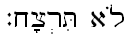
inside our own bodies, is this a sensible statement? In the book
of Exodus (20:13) we're told that one of the commandments given
to Moses was:
The King James version did in fact translate this commandment
as "Thou shalt not kill", although the significant word here is
the Hebrew term ratsach, which could possibly signify killing
for any reason, but more importantly it can specifically signify an
act of killing due to anger or hatred. In that case, the
commandment is not so much about the act of killing as it is
about anger and hatred.
Along these same lines, there is an old teaching story, offered
in many different forms to many different cultures, which may offer
further insight into this issue:
Once a samurai was in the midst of a lesson with his beloved
teacher, when an angry villain suddenly appeared, shouted hateful
words, killed the samurai's teacher, and escaped. According
to tradition, the samurai was then duty-bound to track down
and kill this heinous villain.
After some effort, the samurai finally found the villain,
and as he raised his sword to take the villain's life, the man
spat in the samurai's face. The samurai abruptly stopped and
sheathed his sword.
The villain said, "I don't understand.
You were about to kill me, and yet after I spit at you, you
have now spared my life. Why?"
The samurai replied,
"I was going to take your life because it was my duty to kill
you, but when you spat in my face, that angered me. Had I killed
you then, I would have been a murderer, because I would have
struck in anger. I will fight for my duty, but I will not murder
for my ego."
Thus, it is our egocentric anger, hatred and self-righteousness
that we are being cautioned to avoid, as is discussed by Jesus in
the sermon on the mountain:
You have heard that the ancients were told, `thou shall not
kill' and `whoever kills shall be liable to the court.' But
I say to you that everyone who is angry with his brother shall
be guilty before the court; and whoever says to his brother,
`You good-for-nothing,' shall be guilty before the supreme court;
and whoever says, `You fool,' shall be guilty enough to go into
the fiery hell.
Clearly, we must strive to honor Life, respect Life, treat Life
with loving kindness, tenderness and generosity. Then, with such
a loving attitude, whatever happens will be in harmony with Life
itself.
In the Qur'an there is a wonderful parable about Moses being
instructed in the ways of the One by a mystical teacher (often known
as khidr, the green man):
Moses met Khidr, a teacher of Divine wisdom, and asked "May
I follow you, and learn of the Higher Teachings?", to which
Khidr agreed, as long as Moses would agree to have the patience
to understand and thereby actually learn something about the
Divine ways.
Soon, they set out in a boat, and Khidr promptly made a hole
in the boat, which later caused the boat to sink. Moses became
quite upset and protested Khidr's sinking of the boat,
but they went on.
Next, they met a young boy and Khidr killed the boy. Again
Moses became quite distressed and again protested Khidr's actions,
but they went on.
Then they encountered a wall that was in disrepair and about
to fall down, which Khidr took time to repair. Again Moses was
bewildered, and wondered why this apparent murderer would spend
out of his own pocket and use his own time to repair someone
else's wall.
Finally, realizing that Moses was not understanding the meaning
of any of these actions, Khidr said: "Now will I tell thee the
interpretation of (those things) over which you were unable
to hold patience:
As for the boat, it belonged to certain
men in dire want: they plied on the water: I but wished to render
it unserviceable, for there was (chasing) after them a certain
king who seized every boat by force.
As for the youth,
his parents were people of Faith, and we feared that he would
grieve them by obstinate rebellion and ingratitude (to Allah
and man). So we desired that their Lord would give them in exchange
(a son) better in purity (of conduct) and closer in affection.
As for the wall, it belonged to two youths, orphans, in
the town; there was, beneath it, a buried treasure, to which
they were entitled: their father had been a righteous man: So
thy Lord desired that they should attain their age of full strength
and get out their treasure - a mercy (and favour) from thy Lord.
I did it not of my own accord. Such is the interpretation of
(those things) over which you were unable to hold patience."
Qur'an, sura al-kahf (18:65-82)
This parable reminds us that our human viewpoint is very limited,
and that if we wish to understand the events of human life and learn
to be in harmony with Life itself, we must strive for a deeper understanding,
an understanding beyond the limitations of any self-centered style
of understanding.
All tragedy of life, all misery and inharmony are caused
by one thing and that is lack of understanding. Lack of understanding
comes from lack of penetration. The one who does not see from
the point of view from which he ought to see becomes disappointed
because he cannot understand. It is not for the outer world
to help us to understand life better; it is we ourselves who
should help ourselves to understand it better.
One should be full of courage and confidence in the face
of difficulty and seeming trouble, by recognizing that there
is a mighty power, that there is a perfect wisdom behind one,
and that all will be well. Through this a person will rise above
his limited power and wisdom, and will be able to draw power
and wisdom from that unlimited source which in the end will
lead him to success. Then even in the case of failure this recognition
of a perfect power and wisdom working beside oneself will give
one the strength to bear it, and to be resigned to the will
of God.
In the Bhagavad-Gita, lord Krishna tells the ever-bewildered
Arjuna:
The wise grieve neither for the living nor for the dead.
There has never been a time when you and I and the kings gathered
here have not existed, nor will there be a time when we cease
to exist.... One man believes he is a slayer, and other believes
he is slain. Both are ignorant; there is neither slayer nor
slain... Unborn, eternal, immutable, immemorial, you do not
die when the body dies... The Self cannot be pierced by weapons
or burned by fire.
Bhagavad-Gita, Chapter II, tr by Eknath Easwaran
Everything that is born must die, but there is a part of us,
the most wondrous part, that never dies. And rather than focusing
our attention on the inevitable change of form, which seems to be
the end of life, lord Krishna urges Arjuna to raise his ideals a
bit higher, to raise his attention beyond the issues of birth and
death, and to focus his attention solely upon the One Cause that
is behind all of the apparent causes:
The foolish do not look beyond physical appearances to see
my true nature as the Lord of all creation. The knowledge of
such deluded people is empty; their lives are fraught with disaster
and evil and their work and hopes all are in vain... I am the
father and the mother of this universe, and its grandfather
too. I am its entire support... I am the goal of life, the Lord
and support of all, the inner witness, the abode of all. I am
the only refuge, I am the one true friend, I am the beginning,
the staying and the end of creation... I am immortality and
I am death... Therefore having been born in this transient and
forlorn world, give all your love to me. Fill your mind with
me; love me; serve me; worship me always. Seeking me in your
heart, you will at last be united with me.
Bhagavad-Gita, Chapter IX, tr by Eknath Easwaran
Again, the message is clear -- in order to make spiritual progress,
we must rise above mere appearances, and discover the glory and
wonder of the One Cause who is behind all causes. Paraphrasing the
saying attributed to Mansur al-Hallaj: ana al-hayy, I am
Life! In order to rise out of our self-centered rut, we must focus
our attention on the Truth, always remembering the One Life in whom
we all exist and move and breathe.
They should seek the Lord, if haply they might feel after
him, and find him, though he be not far from every one of us:
For in him we live, and move, and have our being
All of creation is in continual change, with various forms coming
into being, existing for some time, and then disappearing. In our
confusion, we become attached to certain forms, and we are greatly
distressed when the appearance of that form changes. We may call
it death, but it is really only a change of form. Life goes on.
If living is an innate desire, then it is most necessary
to find the process, the way how to get in touch with that real
part of ourselves, which may be called our being, our self,
and thus to become free from what is called mortality. It is
the ignorant one who knows only the ground floor of his house.
By going to the first floor of his house, he thinks that he
is dead. He does not know that he has only left the ground floor
and is going to the first floor. Why does this ignorance exist?
Because he never tried to go to the first floor. The ground
floor is quite enough for him. The first floor does not exist
for him, though it is a floor in his own house.
Is immortality
to be gained, to be acquired? No, it is to be discovered. One
has only to make one's vision keener, in other words, to explore
one's self. But that is the last thing one does. People are
most pleased to explore the tomb of Tut-ankh-Amen in Egypt,
in order to find mysteries, regardless of the mystery hidden
in their own heart. Tell them about any mystery existing outside
themselves: they are delighted to explore it. But when you tell
them to see in themselves, they think it is too simple. ...
The saying of the Prophet is, 'Die before death.' What does
it mean? It does not mean commit suicide. It only means: study
the condition of death. One need not die, play it; one should
play death and find out what it is. The whole mystical cult
is that play, playing death. That play becomes the means by
which to understand the mystery hidden in life.
Nonetheless, one must always respond with compassion and sympathy
to all who are suffering, even when they are the cause of their
own misery. And, by rising above one's own egocentric viewpoint
and the consequential suffering, one is then much better equipped
to offer a greater quality of sympathy, compassion and healing to
those who lack understanding.
When one has acquired knowledge, power, magnetism, he becomes
conscious of having greater power than others, of knowing more
than others, of being able to achieve more than others. To use
these faculties rightly is another struggle. He should not pride
himself on these accomplishments. There is an enemy who starts
with him on the journey and never leaves him: his pride and
spiritual egotism and this enemy stays with him as long as he
is on the path.
It is a great temptation to think, on
having received inspiration and power, 'I can do, know, understand
more than you.' It is a constant struggle until the end, and
at any moment one may stumble and fall down. Only the steadfast
traveler will persist in rising up every time, for without patience
he may lose his way. But those who journey on this path will
get help; as Christ said, 'Seek ye first the kingdom of God
and all these things will be added unto you.'
Sympathy is an awakening of the love element, which comes
on seeing another in the same situation in which one has been
at some time in one's life. ... That person is living whose
heart is living, and that heart is living which has wakened
to sympathy. ... No doubt love, affection, or sympathy without
wisdom may seem profitless, as for instance, if a person was
crying with pain and his sympathetic friend, on hearing his
cry, began to weep with him, doubling his pain.
Sympathy can only be useful when man does not make the condition
of the person with whom he sympathizes worse, but makes things
better. The feeling of sympathy must be within, it need not
manifest purely as sympathy but as an action to better the condition
of the one with whom one has sympathy. There are many attributes
found in the human heart which are called divine, but among
them there is no greater and better attribute than sympathy,
by which man shows in human form God manifested.
Mere appearances can be deceiving, so the wise strive to see
beyond the mere appearance and to discover That Which the appearance
points toward. To understand Life, one must awaken to the Cause
which is behind the apparent cause, the wonder of Life that is beyond
the bounds of birth and death. When situations do not make any sense
to us, the misunderstanding is often caused by our viewpoint.
Without trying to go into big definitions and discussions
of things in actual practice, we might say first that spirituality
manifests most tangibly in how we deal with problems, especially
in relationships with people; secondly, in whether we unfold
the potentialities in our being and how we unfold them; and
finally, in absolute crystal-clear understanding of what lies
behind the appearance of things – not being caught up in the
appearance but really seeing the "cause behind the cause and
the purpose beyond the purpose."
The Call of the Dervish, Pir Vilayat Khan, p158
'Unless the soul is born again it will not enter the kingdom
of heaven'. Being born again means that the soul is awakened
after having come on earth, and entering the kingdom of heaven
means that this world, the same kingdom in which we are standing
just now, turns into heaven as soon as the point of view has
changed. Is it not interesting and most wonderful to think that
the same earth we walk on is earth to one person and heaven
to another? And it is still more interesting to notice that
it is we who change it; we change it from earth into heaven,
or we change it otherwise.
This change comes not by study,
nor by anything else, but only by the changing of our point
of view. I have seen people seek after truth, study in books
about it, write many books on theology, and in the end they
were in the same place where they were standing before. This
shows that all outer efforts are excuses. There is only one
thing that brings us before reality and that is the awakening
of the soul.
All tragedy of life, all misery and inharmony
are caused by one thing and that is lack of understanding. Lack
of understanding comes from lack of penetration. The one who
does not see from the point of view from which he ought to see
becomes disappointed because he cannot understand. It is not
for the outer world to help us to understand life better; it
is we ourselves who should help ourselves to understand it better.
"Awakening" is a key word: it means that we have awakened
from our personal vantage point or perspective. Everything looks
totally different, and by the fact that you see what lies behind
things, you unfold.
The Call of the Dervish, Pir Vilayat Khan, p175
The egocentric viewpoint imagines that life is for the benefit
of "me", but such is not the case. In reality, life is not created
for "me", but rather this "me" has been created for the benefit
of Life. The difference between these two viewpoints is vast. In
the former attitude, one finds great limitation, confusion and suffering.
But when the viewpoint changes from self-centered to self-less,
a new realm of understanding is discovered, a realm of unlimited
understanding, clarity and peace.
Our limited viewpoint regarding "my" life is a result of our
limited thinking, our thinking about "me", our identification with
a particular form the we consider to be "me". But when we begin
to see "me" in every form, and begin to see the Divine Presence
in every form, then we are no longer attached to any particular
form. This awakening depends only upon changing our point of view.
All the violence, fear and suffering
that exists in this
world
comes from grasping at "self".
What use is this
great monster to you?
If you do not let go of the "self",
there will never be an end to your suffering.
To see the Cause behind the cause, to see the wonder of Life
that we have misinterpreted as a "my" life or "your" life, only
requires a change of viewpoint. If we stand in the midst of a jungle,
we cannot see very far, but when we stand on a mountaintop, we can
see a vast panorama, yet the world did not change, it is only one's
viewpoint that has changed. Similarly, to see enduring Life, rather
than merely ephemeral life, one needs only to change one's point
of view by rising above the dense jungle of "me" and standing firmly
on the spacious mountaintop of selflessness.
Life does not die. Life cannot be killed. Life lives.
Wishing you love, harmony and beauty,
wahiduddin
posted August 02, 2006